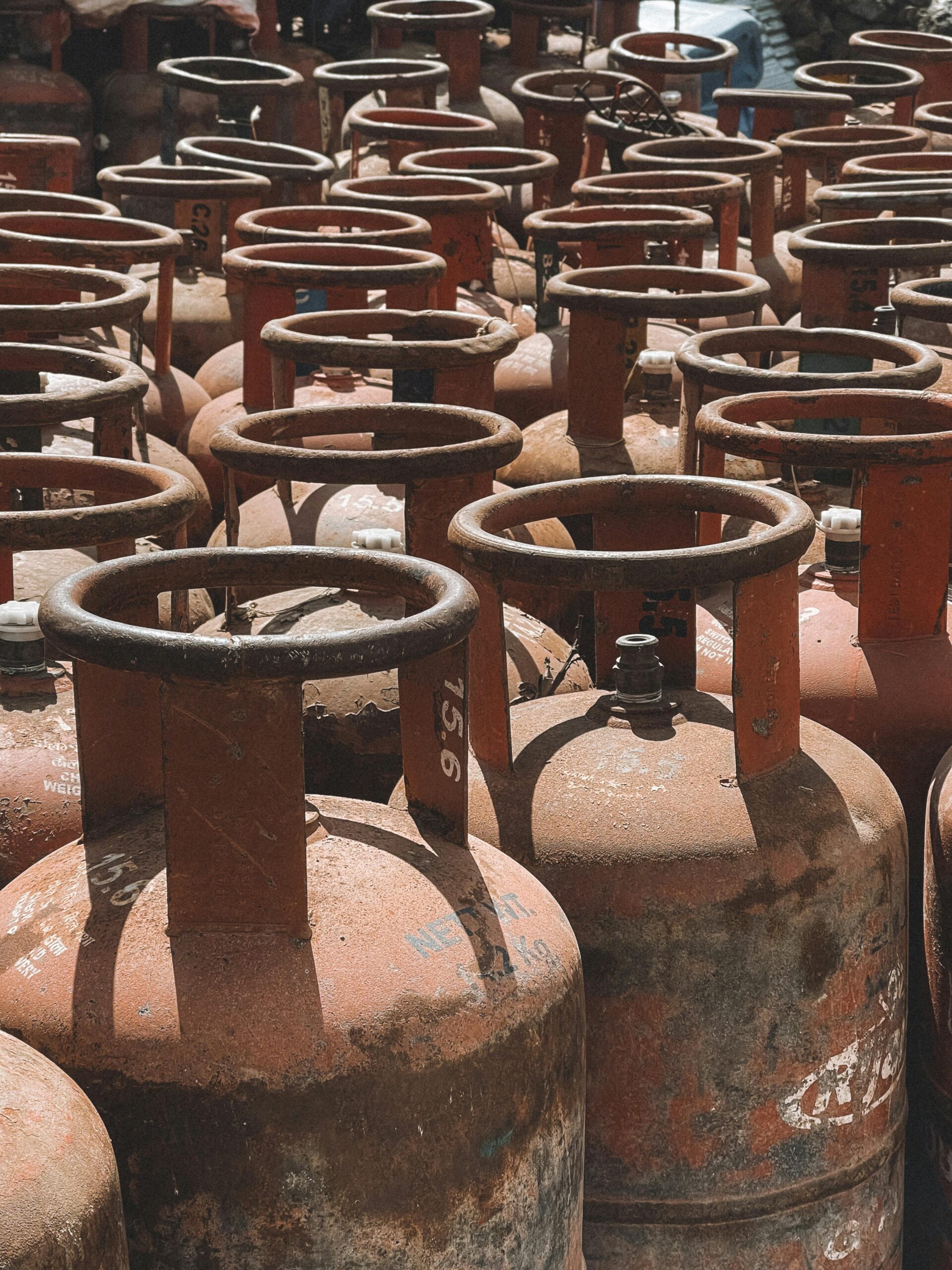
March 2026 — and India’s most essential kitchen fuel is suddenly, alarmingly scarce.
The Scene on the Ground
Long queues outside gas agencies. Restaurant owners staring at empty cylinders. Hotel kitchens going cold. Community kitchens rationing their last reserves. The LPG shortage has caused panic buying, long queues at gas agencies, commercial shutdowns, and rising black-market prices — especially in major cities like Delhi, Mumbai, Bengaluru, Chennai, and Kolkata. In some cities, cylinders are reportedly being sold on the black market at ₹5,000 per cylinder, far above the official price.
For hotels, hostels, restaurants, and community kitchens — the commercial backbone of India’s food economy — the situation has moved from inconvenience to existential threat. As one industry voice put it plainly: “It is a question of survival, not viability. Yes, the costs will be slightly higher. But we need to manage that.” Those with electric cooking equipment are now breathing easier. Those without are scrambling.
How Did We Get Here? The Root Cause
One Strait. One Shock. One Billion Kitchens.
The crisis has a single, dramatic trigger: the escalating conflict in West Asia. For the first time in recorded history, the Strait of Hormuz — through which 20% of global crude, 20% of global natural gas, and 20% of global LPG flows — has been effectively closed to commercial vessels.
For most countries, this would be serious. For India, it is a structural emergency.
India’s LPG imports account for around 60% of domestic consumption, and about 90% of those imports normally move through the Strait of Hormuz. Thus, roughly 54% of normal LPG availability is under direct exposure if the corridor remains shut.
Why India Is So Exposed
India’s LPG supply system relies heavily on continuous imports arriving on schedule. India currently has LPG storage capacity of around 1.34 million tonnes, yet the country consumes roughly 90,000 tonnes of LPG every day — meaning existing storage infrastructure can cover only about two weeks of national consumption. Because LPG must be stored under pressure or at very low temperatures, building large storage buffers is far more complex and expensive than storing petrol or diesel.
Petrol and diesel remain widely available in India because the country has strong refining capacity, diversified crude imports, and better storage buffers. LPG, however, relies heavily on imports passing through a single critical shipping route. That asymmetry is now playing out in real time.
Why Petrol Is Fine but Gas Is Not
This puzzles many people. The answer is structural. LPG is not a by-product of crude refining in the same proportion as petrol or diesel. Even if refineries manage to increase LPG output by 10–20% above current domestic production, domestic supply would only rise to roughly 47–50% of total demand, leaving a significant gap that must still be filled through imports. There is no domestic production fix large enough to close a 54% import hole overnight.
The Human and Economic Cost
Restaurants on the Brink
The National Restaurant Association of India (NRAI) has called it a “crisis situation” that will lead to the closure of many restaurants. NRAI president Sagar Daryani told CNBC that 90% of restaurants in India rely on LPG cylinders to run their kitchens, and that if the LPG supply issues persist, it would lead to “closure of business and job losses.” The NRAI represents over 500,000 restaurants across India — an industry generating annual turnover of over ₹5.7 trillion and employing over 8 million people.
Nearly 10,000 establishments were set to shut down in Tamil Nadu alone, including the majority of small and medium-sized restaurants, according to the Chennai Hotel Association. Mumbai’s AHAR lobby group warned that many of its members are on the “verge of closure.”
The Household Anxiety
As of January 2026, India has around 332.1 million active domestic LPG connections and 104.29 million Pradhan Mantri Ujjwala Yojana (PMUY) connections — connections that were specifically created to bring clean cooking to India’s poorest households. The irony is sharp: a welfare programme built to lift people off firewood and coal could, if the crisis deepens, push them back toward exactly those fuels.
The LPG shortage threatens to push poorer Indian households back to coal — exactly what the Modi government’s Ujjwala scheme spent years phasing out.
What the Government Is Doing
The government has moved quickly, invoking emergency powers and restructuring the supply chain:
Emergency legal orders: The government issued the Natural Gas Control Order on March 9, 2026, under the Essential Commodities Act, 1955. The LPG Control Order issued on March 8, 2026 directed all Indian refineries to maximise LPG yields by channelling all C3 and C4 hydrocarbon streams — propane, butane, propylene, and butenes — exclusively to Oil Marketing Companies for domestic cooking gas. LPG production increased by 28% within just 5 days of the directive.
Household prioritization over commercial supply: The government made a difficult but deliberate choice — directing oil marketing companies to prioritize supplying LPG to the 330 million households that use it as a primary cooking fuel, over the 3 million businesses that use commercial cylinders.
Supply diversification: India is increasing LPG sourcing from the US, Norway, Canada, and Russia. India had already arranged a 2.2 MTPA US LPG deal for 2026, equivalent to about 10% of annual imports. On March 15–16, 2026, two Indian-flagged LPG carriers — Shivalik and Nanda Devi — successfully crossed the Strait of Hormuz carrying more than 92,000 metric tonnes of LPG to India. A partial relief, but still just about 5% of monthly import needs.
Anti-hoarding and price controls: The government has taken the responsible course — to regulate commercial LPG with clear priorities and a transparent allocation mechanism. A three-member committee comprising Executive Directors from IOCL, HPCL, and BPCL was constituted on March 9, 2026. In a major decision, 20% of the average monthly commercial LPG requirement will be allocated by OMCs in coordination with state governments to ensure there is no hoarding or black marketing.
Price protection for the poor: Despite the Saudi Contract Price rising 41% between July 2023 and March 2026, the PMUY beneficiary price has actually fallen 32% in the same period and stands at ₹613 per 14.2 kg cylinder in Delhi. The non-subsidised consumer price stands at ₹913, against a market-determined price of approximately ₹987.
The Alternatives: What Do You Do When the Gas Runs Out?
For Households
Induction cooktops are the fastest, cleanest pivot. Induction stove sales have already surged amid fears of shortage, showing how quickly households respond when reliability is threatened. These appliances use electricity to heat cookware directly and can perform many tasks normally handled by LPG stoves. The upfront cost is modest, running costs are comparable, and the technology is mature.
Microwave ovens offer a partial bridge — microwaves can help households manage short-term LPG shortages by reheating leftovers and preparing quick meals. Ready-to-eat food, frozen items, and simple recipes can be handled without using gas stoves.
Biomass and traditional stoves remain a short-term rural fallback, though they reverse hard-won public health gains from the clean cooking transition.
For the Hospitality and Restaurant Sector
The commercial kitchen is where the survival calculus is starkest. Hotels and restaurants that invested in electric or induction-based cooking infrastructure are now quietly relieved. Those fully dependent on LPG cylinders face the hardest choices.
The Ministry of Environment, Forest and Climate Change has advised State Pollution Control Boards to permit, for the duration of the crisis, the use of biomass, RDF pellets, and kerosene/coal as alternate fuels for the hospitality and restaurant segment for one month — enabling a wider range of establishments to switch and free up LPG for priority consumers.
The medium-term answer for urban commercial kitchens is a mix of electric induction cooking, piped natural gas (PNG) where infrastructure exists, and biogas where feasible.
The Longer Structural Answer
More durable domestic hedges include electric cooking and bioenergy. India has 143.60 GW of cumulative solar capacity, and 195 compressed biogas plants are being set up across the country. Over time, a diversified cooking-energy mix would reduce exposure to any single external fuel route.
Piped Natural Gas can help in urban areas, though it also partly depends on imported gas. The longer-run problem concerns energy security more broadly — a country of India’s scale cannot allow clean-cooking resilience to depend excessively on a single imported fuel passing through a single strategic chokepoint.
The Structural Lesson India Cannot Afford to Ignore
This crisis is not just about a war. It is about decades of policy choices that concentrated India’s cooking energy dependency on a single imported fuel, sourced predominantly from a single geopolitical region, flowing through a single maritime chokepoint.
The resilience-efficiency trade-off is stark: concentrated sourcing is cheaper in stable periods, but diversified supply networks reduce vulnerability when shocks hit. India should treat alternative supply contracts as insurance rather than as an expensive deviation from normal procurement. More storage, terminal flexibility, rail evacuation, and pipeline connectivity would reduce the cost of using that insurance.
The good news, if there is any in a crisis, is that this disruption is forcing exactly the diversification that energy security analysts have long recommended. Induction cooktop sales are surging. PNG connections are being sought out. Biogas is being reconsidered. Households and businesses that were waiting for a reason to transition are now finding one.
Conclusion: Survival Mode is Also a Signal
The hotels, hostels, and community kitchens now rationing their gas, eyeing electric cooktops, and calculating revised cost structures are not just managing a crisis. They are glimpsing the future of India’s cooking energy mix — one that is more distributed, more resilient, and less hostage to a single narrow strait on the other side of the world.
The transition will cost more in the short run. But as the restaurant owner said — it is a question of survival, not viability. And sometimes survival is the best teacher.
Written in March 2026, as the crisis continues to unfold.
Leave a Reply